
Pregnancy ultrasounds are a special and important part of prenatal care. They give you and your care team a close look at how your baby is growing and developing. Using gentle sound waves, we can see detailed images of your baby and the surrounding structures in the uterus, all without any needles or radiation.
These scans can sometimes pick up concerns early, so we can plan the best care if needed. Just as importantly, they offer many parents reassurance and a chance to connect with their baby long before birth.
DATING SCAN
The dating scan is usually done in the first trimester, most often between 8 and 12 weeks of pregnancy.
This scan helps confirm how far along your pregnancy is, gives a more accurate due date, and checks how many babies you are expecting. It can also sometimes pick up early developmental concerns so that your care team can support you appropriately.
During the appointment, the sonographer will gently measure your baby to estimate their age and look for a heartbeat. For many parents, seeing and hearing this for the first time is a very special moment and can be wonderfully reassuring in the early weeks.
Nuchal Translucency (NT) / Early Structural Assessment Scan + Non-Invasive Prenatal Testing (NIPT)
The nuchal translucency (NT) scan is a specialised ultrasound usually done between 11 and 14 weeks of pregnancy.
During this scan, we measure the small pocket of fluid at the back of your baby’s neck, called the nuchal translucency. When combined with a blood test, this helps assess the chance of certain chromosomal conditions, such as Down syndrome.
At this stage of pregnancy we can often also perform a detailed early structural check of your baby. In addition, the NT scan provides an opportunity to look for signs of placental problems, including the risk of pre‑eclampsia later in pregnancy – a condition where the mother’s blood pressure rises and can lead to complications if not monitored and managed.
Morphology Scan
Often called the anatomy or mid‑pregnancy scan, the morphology scan is usually done between 18 and 22 weeks.
This is a detailed check of your baby from head to toe. The sonographer will look carefully at your baby’s organs, limbs and overall anatomy to see how everything is developing, and will also assess the placenta, amniotic fluid and umbilical cord.
For many parents, this scan feels like a big milestone. It gives a more complete picture of your baby’s growth and can be a very exciting and reassuring moment in the pregnancy.
Growth & Wellbeing Scan
Growth scans are usually performed in the third trimester to keep an eye on your baby’s size, growth and position. They can be especially helpful if there are particular concerns about your health or your baby’s wellbeing.
During the scan, the sonographer will gently measure different parts of your baby’s body to check that growth is on track. We’ll also look at how well the placenta is working and measure the amount of amniotic fluid, to make sure your baby has the best possible environment to continue growing and developing.
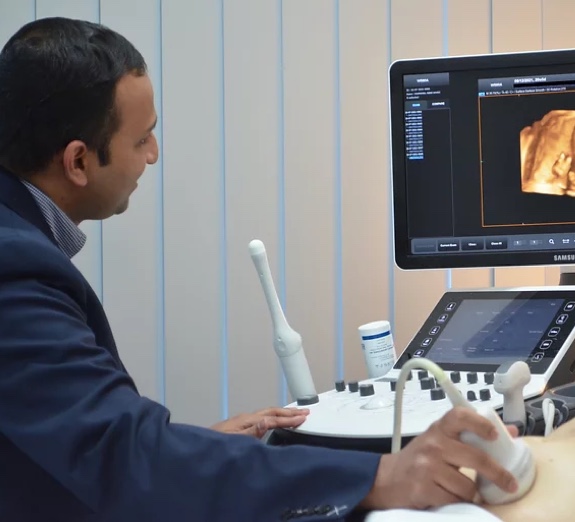

Pregnancy ultrasounds play a vital role in watching over the health of both mother and baby, helping to detect and manage a range of conditions so that care can be tailored to your needs throughout the pregnancy.
Placenta previa is a condition where the placenta lies low in the uterus and covers all or part of the cervix. This can cause complications during labour and birth. Ultrasound is the safest way to detect placenta previa early, so your care team can monitor you closely and make a plan for the safest possible delivery for you and your baby.
Fetal growth restriction (FGR), also called intrauterine growth restriction (IUGR), is when a baby is smaller than expected for their gestational age. Ultrasound scans allow us to closely track your baby’s growth over time, check blood flow through the placenta and cord, and monitor their wellbeing. This helps your care team decide on the safest plan and timing for birth to support the best possible outcome for your baby.
Detailed anatomy scans can sometimes pick up structural differences such as heart defects, cleft lip or neural tube defects. Finding these changes early means your care team can plan the most appropriate support, both during the pregnancy and after your baby is born.
Ultrasound can also detect ectopic pregnancies, where a fertilised egg implants outside the uterus instead of in the uterine lining. Finding this early is very important, as it allows your care team to act quickly and provide the safest possible treatment for your health.
Non‑invasive prenatal testing (NIPT) is currently the most commonly requested early pregnancy screening test. It looks at small fragments of your baby’s DNA in your blood to assess the chance of trisomy 21 (Down syndrome) and other common chromosomal conditions.
Another important option for screening is the Combined First Trimester Screen (CFTS), previously known as the Nuchal Translucency scan. Even if you choose to have NIPT, CFTS is still recommended, as it provides additional information about your baby’s development and the pregnancy that NIPT alone cannot offer.
Bundle Inclusions



If you wish to make a booking with one of our specialists or allied health team, please get in touch with our friendly support staff.
We understand the need for women-led care and have an easy referral system to other health care professionals who provide a range of services specialised to your individual needs.